

You've been working on the wrong problem
Almost no stuck founder has the problem they're certain they have. I spent months figuring out why

You can usually tell within about ten minutes.
I’ve sat with enough founders now over the past 20 years that there’s a specific moment I wait for. They’re walking me through the business, telling me what’s wrong, and they’re confident about it, because they’ve thought about this more than they’ve thought about almost anything else in their life. And the thing they name is always reasonable. I need more leads. My closing’s gone soft. I can’t find good people. I’m buried in the day to day and I can’t climb out.
None of those are dumb answers. That’s the part that took me years to understand. These are sharp, capable people giving the most honest account they can of their own situation. And they are almost always wrong. Not a little wrong. Wrong in a way that has cost them years and a lot of money.
Because here’s what I started noticing. They don’t just sit with the diagnosis. They’re founders, so they act on it. The one who’s sure it’s leads goes and pours money into lead generation. The one who’s sure it’s closing buys the program, drills the objection scripts, rewrites the offer for the fourth time. The one who’s sure they need help finally makes the hire they’ve been putting off for a year. And then six months later, a year later, I’m talking to them again and they are standing in almost exactly the same place. A little more tired. A little more money gone. And starting, privately, to wonder whether the problem is them.
That last part is the thing I most want you to hear, because it’s where this whole series lives.
Somewhere in the grind, a stuck founder stops believing it’s the business and starts believing it’s them. That they don’t have the discipline. That they’re not focused enough, not consistent enough, not built like the people who seem to make it look easy. It stops being a business problem and becomes a character problem, a personal failing they carry around and don’t say out loud to anyone, maybe not even fully to themselves. And I have come to believe that is the single most expensive misunderstanding in business, because it is almost never true, and it sends people running at the wrong wall for years.
Let me give you the one that made it click for me. A founder, genuinely talented, convinced he was bad at closing. Deals kept dying right at the end. He could feel them slipping in the last conversation, that specific sick feeling, so he did the completely reasonable thing and decided he needed to get better at closing. He studied it. He drilled the scripts. He rewrote his pitch and practiced his objection handling in the mirror. And the deals kept dying. When I finally sat down and looked at the actual shape of his business, he was getting four real conversations a month. Four. He was not bad at closing. He was carrying the unbearable weight of needing every single one of those four to land, and that desperation was leaking into every call, and the desperation was what killed the deals. His closing was fine. His problem sat two full steps upstream, in how he got attention and turned it into conversations, and he had never once looked there, because the pain was at the close, so the close is where he looked. You could have made him the best closer alive and his revenue would not have moved a dollar, because a great close rate on four conversations is still four conversations.
Here’s another shape of the same thing, because it doesn’t only happen in sales. A founder drowning in work, certain the answer is to hire. So she hires. And somehow she’s just as buried, now with a payroll line she didn’t have before. Because the problem was never a shortage of hands. The problem was that nothing in the business was written down, so every new person had to be trained out of her mouth, in real time, which meant the hire didn’t reduce her load, it temporarily increased it. She was bailing water out of a boat that had a hole in it. You can bail forever and never get ahead, and eventually you decide you must be bad at bailing.
That’s the pattern, and once you see it you can’t unsee it. The place it hurts and the place it’s actually broken are almost never the same place. A business is a chain of dependent steps, and when an early link is weak, the strain shows up at a later link, downstream, where it finally becomes visible and painful. So you diagnose the place that hurts. But the place that hurts is the symptom. The cause is sitting quietly upstream, not screaming, which is exactly why you never look at it.
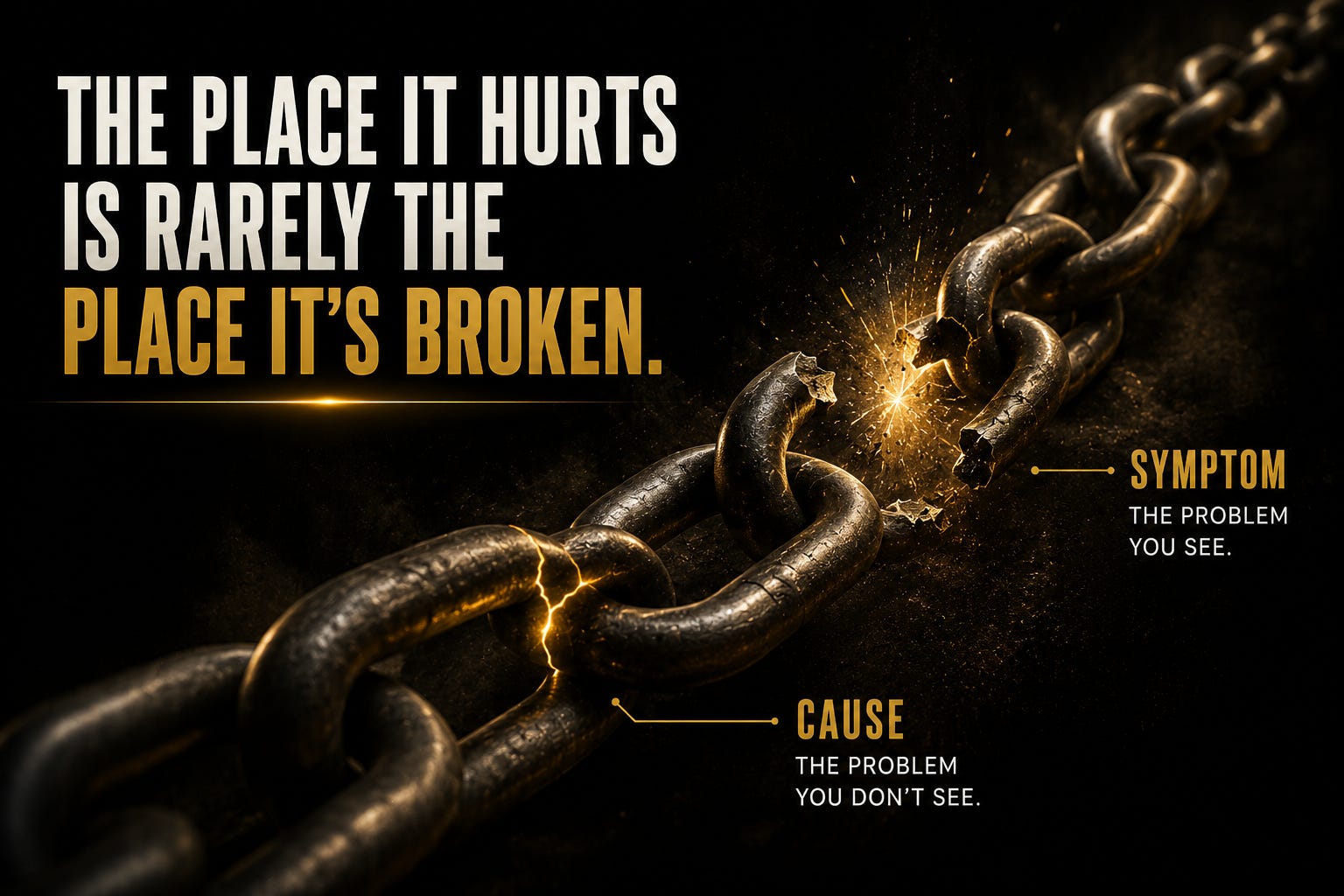
And you cannot see the thing you are standing inside of. That’s not a knock on you. It’s just true. You are too close to your own business to see its structure, because you experience it as a series of daily fires, not as a system with a shape. You feel the lost deal, the bad hire, the fire you put out at 6pm. You do not feel the architecture underneath that keeps generating all of it.
So if you have been quietly blaming yourself, working harder every year and landing roughly where you started, I want to offer you a different frame before you spend another year on it. You are probably not undisciplined. You are probably not missing some gene that the people who made it were born with. You are misdiagnosed. You have been applying real effort, the kind most people never manage to apply, to the wrong problem. And effort aimed at the wrong thing does not give you a small result. It gives you exhaustion, and a year you do not get back, and a slowly growing belief that you are the problem.
Over the next couple of weeks I’m going to take this apart properly. Not tips. You have enough tips; if tips were the answer you’d be done already. I mean the actual structure underneath all of this. Why capable people keep misreading their own businesses, where exactly a business gets stuck, and how to find the one thing that’s actually holding you back instead of the loud thing that just happens to hurt the most.
It starts with something uncomfortable, so I’ll say it now and we’ll build on it. The thing you are most certain about, the diagnosis you’d bet money on, is almost always the symptom. Almost never the cause.
More soon.
About the Author

Nick Ayala is an operator, capital strategist, and author of Capital Is the Game: Business Is Just the Board.
He has built and sold four companies across three industries, and now works with founders on the real reason businesses stall: not a shortage of tactics, but the one hidden constraint that keeps the whole thing dependent on the person who started it. His framework maps the eight places a founder-led business gets stuck, across the two engines every business runs on, how it makes money and how it runs without you.
The work comes from two decades of actually doing it. Four exits across three industries. Raising and structuring private capital across private equity, private credit, and real estate. Operating companies through the parts nobody writes about. Across all of it, he watched the same thing again and again, what actually separates the businesses that break through from the ones that run in place for another year. The bottleneck framework is the distilled version of that.
Nick is the founder of The Come Up, a community and program where founders find their one real constraint and remove it, alongside other founders doing the same work. He writes for founders who are tired of working harder every year and landing in the same place, and who suspect, correctly, that the problem isn’t them.