

The “sorry I’ve been MIA” post
You’re not lazy. You’re waiting for the wrong thing. Why you keep disappearing and coming back

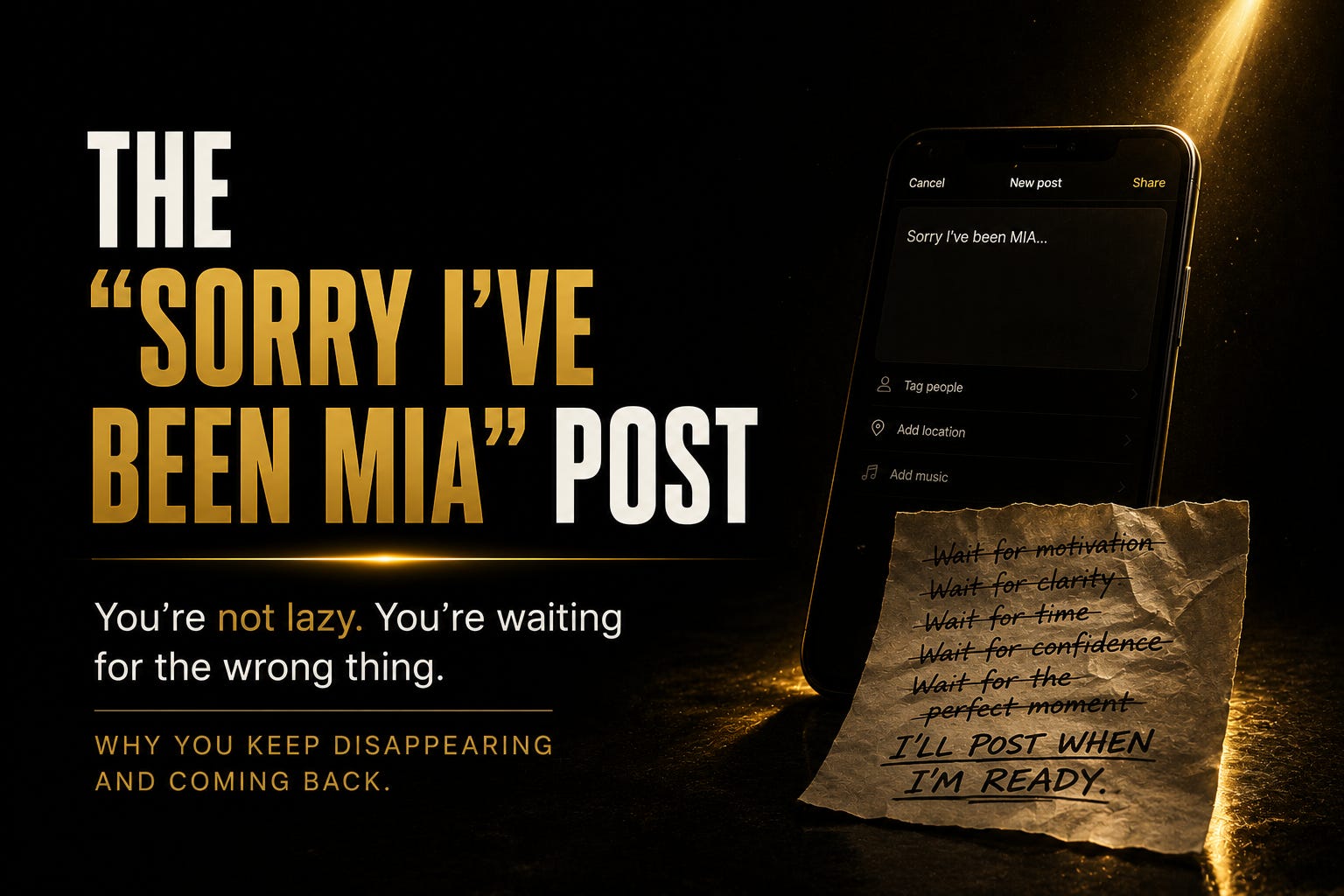
You know the post. You’ve probably written it more than once.
“Hey, sorry I’ve been quiet lately, things got crazy, but I’m back now and I’ve got so much good stuff coming.”
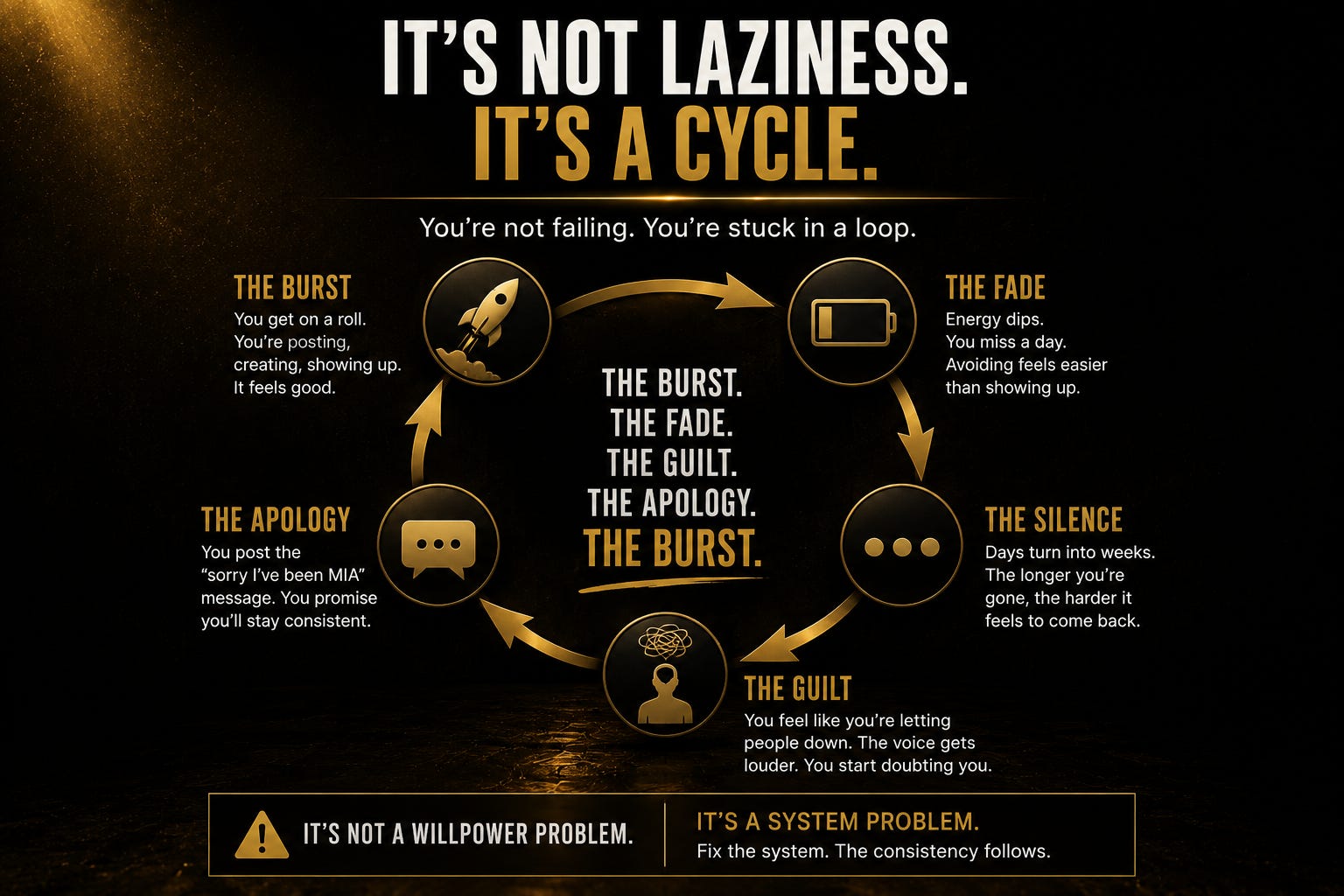
You wrote it because you felt guilty. Because a few weeks before that, you were posting every day. You were on a run. You’d finally cracked it, finally found the rhythm, and it felt great, and then somewhere around day eighteen the energy quietly went. You missed a day. And missing felt worse than the work had, so the next day you avoided it to avoid the feeling, and then a few days were gone, and the longer you were gone the louder the voice got. The voice that says you have people out there who followed you for a reason and you are letting them down, that you have an audience waiting and you are giving them nothing. And eventually the guilt gets heavy enough that you write the apology post, and you promise yourself this time you’ll stay consistent, and for a few days you do, and then it happens again. The burst, the fade, the silence, the guilt, the apology, the burst.
I want to be careful here, because it would be easy to read that and feel called out and ashamed, and the shame is the exact thing I’m trying to take off you, not pile higher.
Because here’s what you’ve decided about that pattern. You’ve decided it’s a discipline problem. That you lack some consistency gene. That the people who post every day for years have a kind of willpower you simply don’t have, and that if you could just be more disciplined, more focused, more whatever, you’d be fine. You’ve made it a verdict about your character.
That is not what’s happening. I’ve looked at this closely, in myself and in a lot of founders, and the people who can’t stay consistent almost never have a discipline problem. They have a decision problem.
Watch what actually happens when you sit down to post. Every single time, from scratch, you are making a pile of decisions. What do I say today. Is this any good. Is this the right hook. Does anyone care about this. Should I post the other idea instead. Is the timing right. Each of those is a small tax, and you pay all of them fresh, every time, before you’ve written a word. So the whole act feels heavy, and heavy things get avoided, and the avoidance feels like laziness when it is actually just a rational response to friction. You are not failing to show up because you are weak. You are failing to show up because you built a process that requires a burst of inspiration as its fuel, and inspiration is the single least reliable fuel there is. Some days it’s there. Most days it isn’t. A system that only runs when you feel inspired is a system that mostly doesn’t run.
And there’s a second thing eating at you that nobody names, which is comparison. You open the app to post and before you can, you see somebody else hitting the milestone, landing the deal, looking three steps ahead of you, and something in you deflates, and now posting feels even heavier because it feels pointless, because look how far behind you are. So you close the app. The very tool you need to use to get unstuck is the one feeding you the reason to quit. That’s not weakness either. That’s a structural trap with your psychology caught in it.
There’s a line I think about a lot. The professional does not wait for the muse. He acts in anticipation of her, because he has learned that when she sees him already at the desk working, she shows up. The amateur waits to feel like it. The pro built something that does not require him to feel like it. That is the entire difference, and notice it has nothing to do with willpower. The consistent ones are not white-knuckling through resistance every single day on raw discipline that you somehow lack. They removed the decisions. They know what they’re posting before they sit down, so sitting down is not a daily moment of dread and self-negotiation, it’s just execution. They made it small enough and clear enough and pre-decided enough that motivation became optional. They engineered the feeling out of it.
So if you’ve been calling yourself inconsistent, lazy, undisciplined, flaky, all the words you use on yourself in private, I want to gently put it to you that you have been diagnosing a character flaw where there is actually just a missing system. The guilt you feel is not evidence that you’re weak. It is evidence that you care, pointed at a structure that was never built to carry it. You don’t have a motivation problem. You have a structure problem that has been masquerading as a motivation problem, and you’ve been paying for it in self-respect.
This is the same shape as the closing founder from last time. The pain shows up in one place, “I can’t stay consistent,” and the cause sits somewhere else entirely. You experienced it as a personal failing. It was a structural gap the whole time, and structural gaps can be closed, which is a very different thing than a character you have to fix.
And content is only one of the places this happens. There are eight. Next time I want to get into the one I see the most, the one that specifically traps the most capable founders, the ones who are genuinely excellent at what they do. It has nothing to do with discipline either. It has to do with letting go, and the real reason you can’t.
About the Author

Nick Ayala is an operator, capital strategist, and author of Capital Is the Game: Business Is Just the Board.
He has built and sold four companies across three industries, and now works with founders on the real reason businesses stall: not a shortage of tactics, but the one hidden constraint that keeps the whole thing dependent on the person who started it. His framework maps the eight places a founder-led business gets stuck, across the two engines every business runs on, how it makes money and how it runs without you.
The work comes from two decades of actually doing it. Four exits across three industries. Raising and structuring private capital across private equity, private credit, and real estate. Operating companies through the parts nobody writes about. Across all of it, he watched the same thing again and again, what actually separates the businesses that break through from the ones that run in place for another year. The bottleneck framework is the distilled version of that.
Nick is the founder of The Come Up, a community and program where founders find their one real constraint and remove it, alongside other founders doing the same work. He writes for founders who are tired of working harder every year and landing in the same place, and who suspect, correctly, that the problem isn’t them.