

Never Defend Your Price
Over 12 million people have watched a 40 second reel about a lowball. Here's the part that didn't fit in 40 seconds.

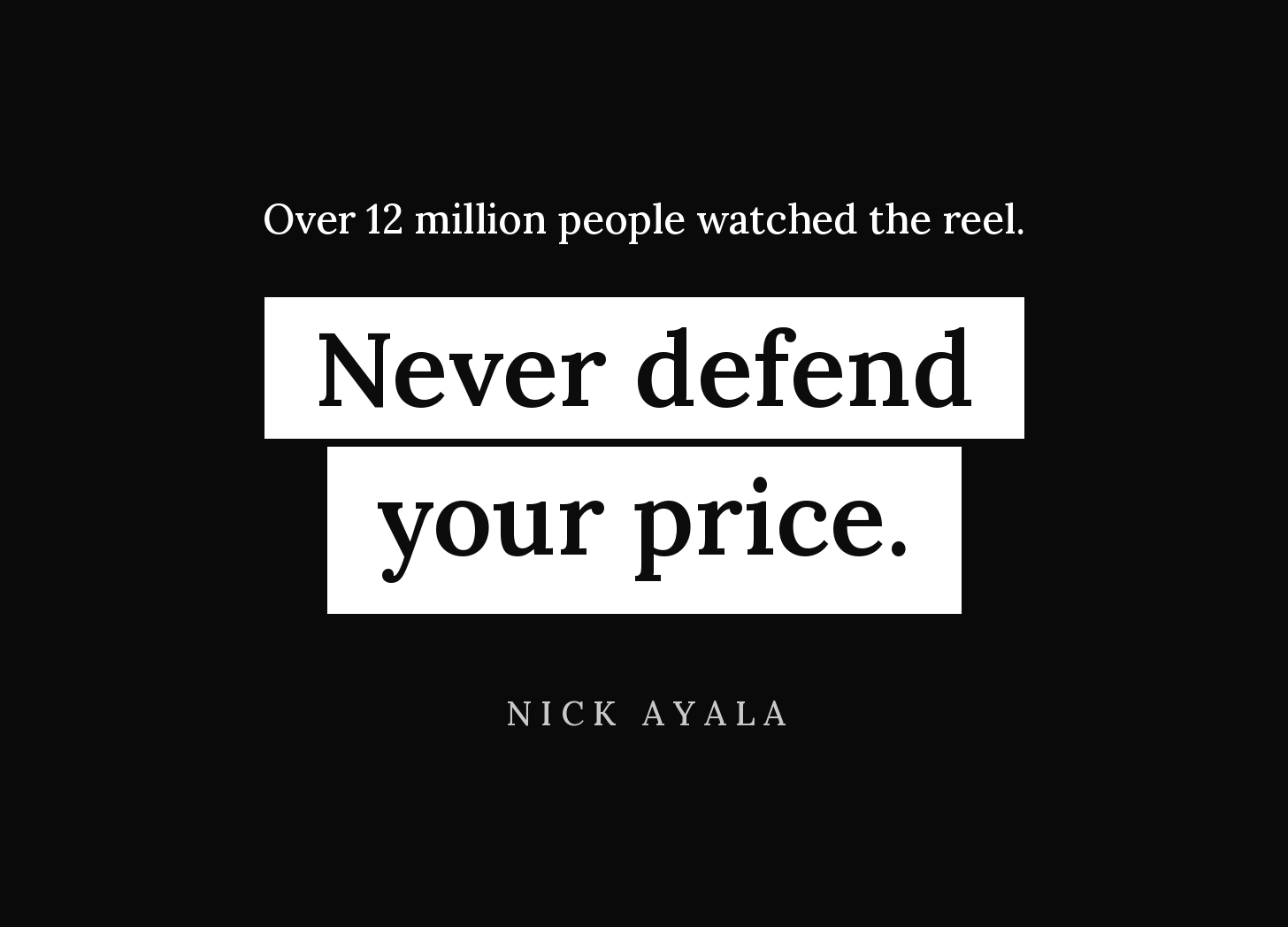
I posted a reel about a lowball offer. Over 12 million people have watched it. 82,000 saved it.
You don’t save something because it entertained you. You save something because you plan to come back to it. 82,000 people watched that reel and thought, I’m going to need these words.
That number tells you something about the reel. It tells you more about the room. Most people are walking around with no script for the moment someone questions their worth. They know the moment is coming. They’ve lived it before. And they know that last time, they folded.
So let’s slow that moment down.
A lowball is not an offer. It’s a question. The number barely matters. What they’re really asking is: how sure are you?
And most people answer honestly. Not with words. With behavior.
They explain. They itemize. They send the follow up email with the breakdown of everything that goes into the price. They defend.
Here’s what two decades of deals taught me about defending.
The person explaining a number is telling you the number is soft. In almost every negotiation I’ve sat in or watched, the same rule holds: the party doing the justifying is the party that’s about to move. Justification is movement. It just hasn’t shown up in the number yet. The other side can feel it coming, so they wait.
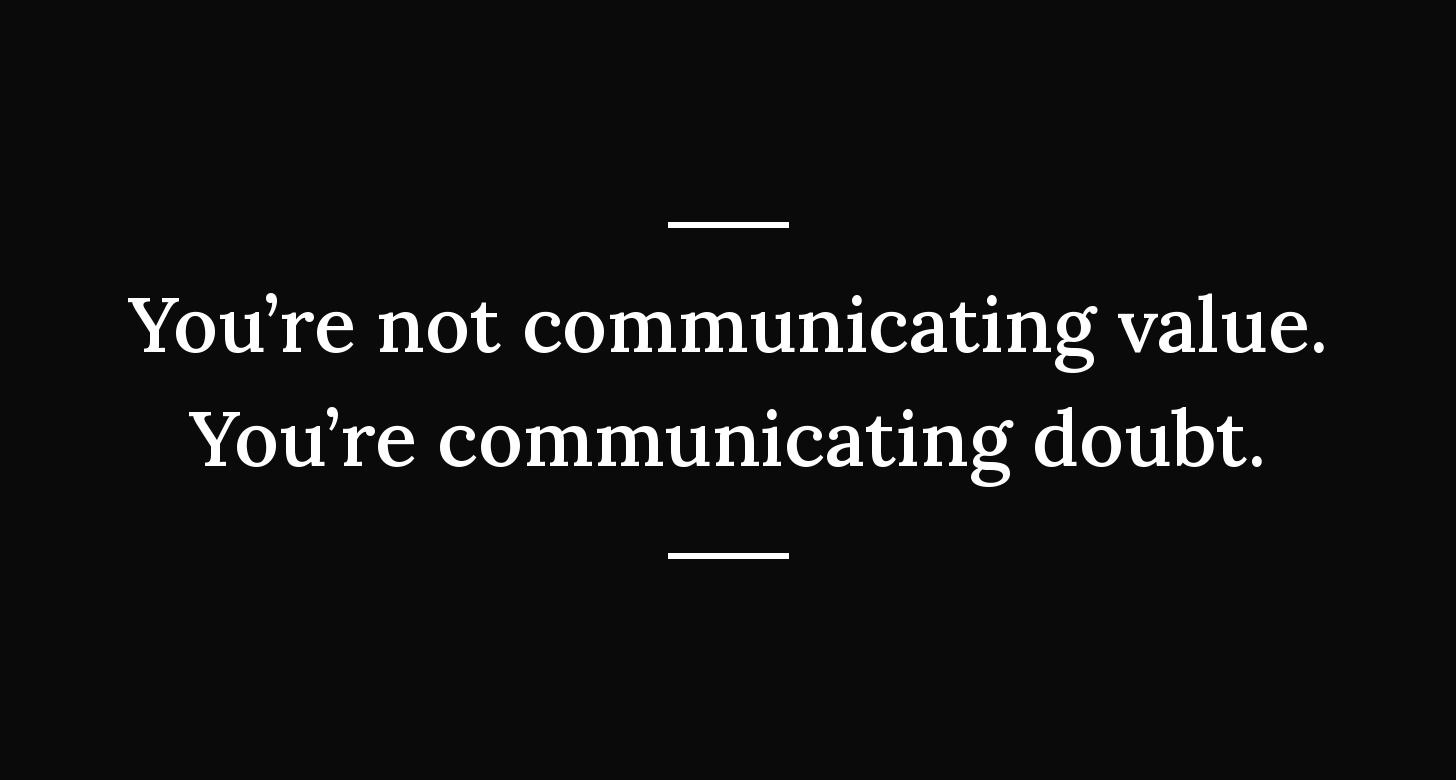
When you defend your price, you think you’re providing information. You are. Just not the information you think. You’re not communicating value. You’re communicating doubt. You’re telling them the number was a request, not a fact.
Think about the prices you never argue with. You’ve never asked a surgeon for a discount. Nobody haggles at the gate at Disney. The businesses you don’t negotiate with are the ones that treat the price like weather. It’s not up for discussion because it was never presented as a discussion.
The price is information about the seller. Always has been.
Now the deeper part. The part I actually wanted to write about, because it doesn’t fit in a reel.
Why do smart people defend their price?
The surface answer is they need the money. Sometimes true. But I’ve watched founders with full pipelines do it. I’ve watched people who didn’t need the deal at all start justifying the second someone pushed back. So it’s not the money.
The real answer is that the low price is protection.
If you charge less than you’re worth, you never have to find out what you’re worth. The discount is insurance against the test. Holding your full price is exposure. If they walk, you have to sit with the possibility that you weren’t worth it. If you cave first, you never have to sit with anything. You just quietly pay for the comfort.
That’s the actual trade most people are making when they call themselves flexible. They’re buying certainty about themselves. And they’re financing it with their margin.
And it compounds, because the client you got by caving is the most expensive client you’ll ever have. Not because they’re a bad person. Because of what the transaction taught them. You taught them the fence moves when it gets pushed. People push fences that move. They’ll ask for more, pay slower, and respect you less, and none of it is their fault. You wrote the rules in the first five minutes.
So what do you do when the lowball comes?
You say the price once. Then you stop talking.
That’s it. That’s the whole move. “The price is X.” Silence after a price isn’t rude. It’s complete. You already said everything.
If they push, you restate. You don’t restate louder. You don’t add reasons. Adding reasons is the tell. The second reason you give is the first inch you’ve conceded.
And underneath all of it, you have to be willing to lose the deal. That’s the part nobody wants to hear, so I’ll say it plainly. A price you’re not willing to lose a deal over isn’t a price. It’s an opening bid on yourself.
Here’s the thing about the 82,000 saves. The words work. I’ve used versions of them across a lot of transactions. But words without the position underneath them is acting, and buyers can smell acting. The reel gave people the script. The script only holds if you’ve decided, before the conversation starts, that the number is true.
Your price is just a boundary with a number on it. And people never respect a boundary you argue for. They respect the one you state once and hold.
Get the position right and you’ll barely need the words.
About the Author

Nick Ayala is an operator, capital strategist, and author of Capital Is the Game: Business Is Just the Board.
He has built and sold four companies across three industries, and now works with founders on the real reason businesses stall: not a shortage of tactics, but the one hidden constraint that keeps the whole thing dependent on the person who started it. His framework maps the eight places a founder-led business gets stuck, across the two engines every business runs on, how it makes money and how it runs without you.
The work comes from two decades of actually doing it. Four exits across three industries. Raising and structuring private capital across private equity, private credit, and real estate. Operating companies through the parts nobody writes about. Across all of it, he watched the same thing again and again, what actually separates the businesses that break through from the ones that run in place for another year. The bottleneck framework is the distilled version of that.
Nick is the founder of The Come Up, a community and program where founders find their one real constraint and remove it, alongside other founders doing the same work. He writes for founders who are tired of working harder every year and landing in the same place, and who suspect, correctly, that the problem isn’t them.